

Aberdeenshire Weekend Study Tour: September 2025
In the Footsteps of Robbie Bogdan
By Norman Mackenzie
Our Study Tour itinerary was devised to encompass many of the castles associated with our late Chairman Robert Bogdan and perhaps explain the passion and expertise that he and his late brother Nicholas had for castellated architecture. Their personal archives form the basis of the new Scottish Castles Archive being developed by the SCA in partnership with Stirling University. The intertwining of the branches of Robert’s family tree would be mirrored in the connections between many of the properties on our tour, and Diana Monteith gave us insights into Robert’s links with many of the places we visited. We would also see a variety of ways in which our built heritage could be, or not be, preserved for modern use.
As an amuse-bouche en route to the feast, we were entertained by SCA Trustee Meg Weir at Castle of Fiddes, sited with commanding outlook, on the side of Bruxie Hill, just south of Stonehaven. The castle was built at the end of the 16th century by an Arbuthnot and his Burnett of Leys wife, possibly even using the same masons as Crathes. (Her brother was continuing the building Crathes in the same decade). It exhibits all the exuberance one might see in the stylistic development of the L-plan tower: the grand staircase wheeling in the re-entrant to the first floor; the double height corner turrets; the square cap-house sitting on label corbelling.


A small band of the more adventurous had previously taken the opportunity to visit the nearby and scant remains of Whistleberry Castle, perched precariously above the North Sea.


James Burnett of Leys accompanied us around Crathes Castle and some 500 years of family history and artefacts. The embellishments seen in the masonry of the upper storeys of the great tower are a testament to the status of Alexander Burnett and his wife Katherine Gordon at the close of the 16th Century. (Clearly his sister could not really compete at Fiddes!) The interior decoration and furnishings they commissioned were equally lavish with the famous suite of painted ceilings and the great oak bed. James finished the tour under the unique oak panelled ceiling of the Long Gallery only rivalled by those of the royal palaces and where the previous Burnett lairds would have held Barony Court. Perhaps the embossed SCA plaque presented to James by our president, Richard Oram, will now allow us to have contributed a small amount to the decorative history at Crathes?


We honoured the Irvine family connections of the Bogdans with a flying visit to Drum Castle. At the end of the tour, we would see a similar 15th century tower and mansion complex with a very different outcome for the Forbes at Druminor.

We were fortunate to have Penny Dransart giving us an expert archaeologist’s view of the development and history of slighted Balquhain Castle, once the centre of power for the Leslies. The four-storey façade seen from the road belies the destruction behind, but Penny was able to show us from the traces extant in the masonry how the rectangular tower was rebuilt and lifted by a storey after a burning by the Forbes in 1526. The footings visible amongst the rubble outlined the later courtyard arrangements. The Leslies’ influence in the north was significant and partly financed by relatives who were appointed Counts of the Holy Roman Emperor in Bohemia.


Sir Archibald Grant took us on the tour of his House of Monymusk, an ancient seat of the Forbes which was falling into disrepair when bought sight-unseen by the ascendant Grant family in 1713. That Sir Archibald set about a series of repairs to the house and agricultural improvements to the poor land of the estate becoming the leading light in the Agricultural Revolution in Scotland. This was partly funded by marrying a series of four heiresses. Whilst the lot of the Scottish farm workers was being improved, some of this was at the expense of those labouring in servitude on the Monymusk Sugar Plantation in Jamaica.

Penny Dransart once again gave us an overview of the latest archaeological research and excavations into crumbling Fetternear House and the remains of the palace complex of the Bishops of Aberdeen that surround it. After the reformation it became a tower and later mansion of the Leslies from Balqhuain. The armorial panel linking Leslie and his Irvine of Drum wife, once prominently displayed, now lurks behind the elderflower!


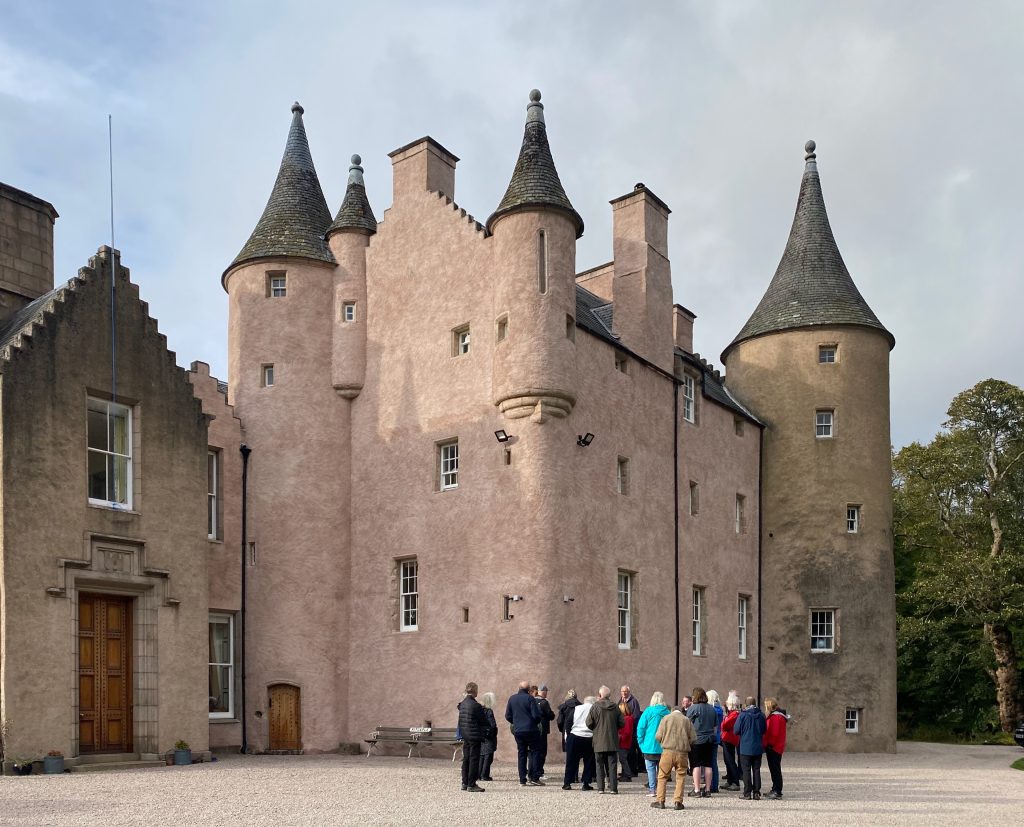
The final visit of the day was to Pitcaple Castle, originally a 15th century moated tower on land granted by James II to a Leslie son of Balquhain. A century later it was converted into the Z-plan edifice we can see by the addition of two towers, the larger, or Thane’s Tower, vaulted on each floor and with its battered walls giving impression of dominating height. It passed to the Lumsdens through marriage and the family still live and farm here. Since we last visited with Robert Bogdan the tower has been reharled and looked quite splendid, especially with the eye being drawn skywards to the remodelling of the roofline which came with the renovations and mansion house extensions done by William Burn around 1830, perhaps a testament to the wealth amassed with successive Lumsdens’ high-ranking positions and directorships in the East India Company.
Our base for the weekend was the intriguing Pittodrie House Hotel, layer upon layer of architectural history starting with the Erskines’ 15th century tower, now hollowed out to form a grand staircase for the neo-Jacobean mansion and further additions from every century.


The isolated ruins of Avochie Castle crown a ridge within sight of the cottage Robert Bogdan leased from the estate of that name. From a distance, with only its gables standing, it could be mistaken for a farmhouse. However, our closer inspection revealed a small, fortified manor house built to Z-plan design in the 16th century, traces of a bartizan still visible.


Andrew Forbes welcomed us to his home, Druminor Castle. His parents had bought the castle back from the Grants in 1955 as once it had been “Castle Forbes”. He discussed the ongoing archaeological excavations outside the building which made all the more sense when we viewed the sketch from the estate papers of the tower that once dominated the courtyard. This tower, the courtyard buildings and the “modern mansion” referred to by McGibbon and Ross have long been demolished leaving a manageable house, as opposed to a property like Drum that requires the intervention of the NTS to maintain.


Nothing excites an SCA member more than being given free range to explore a significant castle they had never visited before, especially one in the first throes of major renovation. Castle Craig or The Craig of Auchindoir beckoned. So, once primed by Penny Dransart with the significance of the vaultings, mouldings, heraldic panels, and architectural details we were about to encounter, we did have fun! The L-plan tower of the Gordon lairds was vast and the recent renovations of the kitchen in the Adam wing were most stylish and impressive bringing facilities into line with modern family living. SCA member Andrew Foreman has a significant project ahead!


Terpersie, or Dalpersie as it once was, has always fired the imagination of the interested visitor, whether it be Billings producing his exquisite architectural drawings or 50 years later, McGibbon and Ross, lamenting its parlous state of repair…It did indeed continue to deteriorate to complete ruin. Perhaps one of the earliest (1561?) examples of the Z-plan designs, but with commodious drum towers, affording relatively spacious extra apartments on each of its three floors.
A wing with grand stair to the first floor and further living space was added in the next century. We were fortunate to have SCA member Mike Tait who oversaw the renovation of the Z-plan house in the 1980s talking about the works. Mirroring the reasoning for better access and more accommodation, a new wing on the 17th century footings was almost completed at the time of our visit with modern lift where the wheel stair once sufficed. A wonderful example of allowing an historic building to continue to be used by its owners.


We concluded our tour at Keith Hall where organisers and Claire Wallace and Barbara Grant have apartments. At its core sits the tall Z-plan tower of Caskieben which was purchased in 1662 by a Keith, the future Earl of Kintore, who soon added an east wing and the very imposing frontage (where we gathered for the group photograph). It was then a very large country mansion. Kit Martin of Historic Houses Rescue divided the house into a series of apartments in the 1980s, giving Keith Hall a new lease of life, and indirectly allowing us to enjoy being hosted to a splendid afternoon tea.
